Electric vehicle adoption in Brooklyn is accelerating as drivers look for ways to avoid rising fuel costs and reduce their environmental impact. You might think installing a home charger is as simple as plugging in a toaster, but in New York City, the reality is a bit more complex. The age of our local grid and the unique layout of Brooklyn properties make this a genuine construction project rather than a quick DIY fix.
We see homeowners struggle with this process daily, often because they underestimate the electrical demands of modern EVs. A standard brownstone or row house wasn’t built to fuel a car, but with the right planning, you can upgrade your home to handle it safely. This guide breaks down the essential equipment, the specific permits you need from the Department of Buildings, and the smart incentives that can lower your upfront costs.
Level 1 vs Level 2 Charging: What Brooklyn Homeowners Should Know
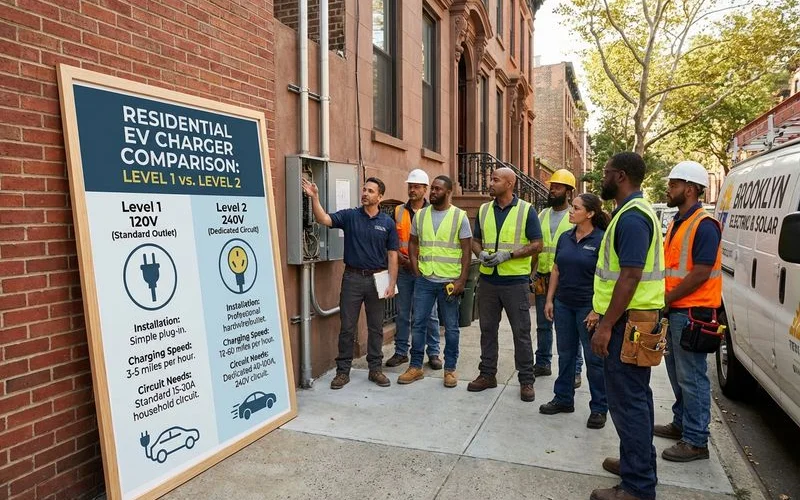
When you purchase an electric vehicle, it typically comes with a Level 1 charger that plugs into a standard 120-volt household outlet. While this equipment requires no special installation, it is painfully slow for modern battery sizes. You will only gain about 3 to 5 miles of range per hour of charging.
For a commuter driving from Bay Ridge to Midtown daily, that trickle charge often isn’t enough to recover the miles used. Level 2 chargers, however, operate on a 240-volt circuit—similar to your electric dryer—and change the equation entirely. These units deliver 25 to 40 miles of range per hour, filling most EV batteries while you sleep.
Here is how the two options compare for a typical EV with a 60kWh battery:
| Feature | Level 1 (Standard Outlet) | Level 2 (Dedicated Station) |
|---|---|---|
| Voltage | 120 Volts | 240 Volts |
| Amperage | 12-16 Amps | 32-50 Amps |
| Charging Speed | 3-5 miles of range per hour | 25-40 miles of range per hour |
| Full Charge Time | 40-50+ Hours | 6-9 Hours |
| Best Use Case | Hybrids or very low daily mileage | Daily commuters & full EVs |
Hardwired vs. Plug-In Level 2 Chargers
You also need to decide how to connect your Level 2 station. A “plug-in” model uses a heavy-duty NEMA 14-50 outlet, similar to a stove plug. This offers flexibility if you ever move, as you can simply unplug the unit and take it with you.
Hardwiring the unit directly into the electrical circuit is often the smarter choice for Brooklyn homes. It eliminates a common failure point—the receptacle itself—which can overheat under continuous load. Hardwired units also often allow for higher charging speeds and are more weather-resistant for outdoor installations.
Electrical Requirements for Home EV Charging
A safe installation relies on components that meet the strict standards of the New York City Electrical Code. Our team always verifies these four elements before we even mount a charger:
Dedicated 240-volt circuit: The charger demands its own exclusive pathway to your electrical panel. Sharing this circuit with a dryer or AC unit is a code violation and a fire hazard.
Appropriate wire gauge: The thickness of the copper wire must match the amperage of the charger. A standard 48-amp hardwired charger typically requires 6-gauge THHN/THWN copper wire run through conduit.
GFCI protection: City code mandates Ground-Fault Circuit Interrupter protection for any outlet installed in a garage or outdoors. This technology cuts the power instantly if it detects a dangerous electrical leak.
Weatherproof installation: Many Brooklyn driveways are uncovered, exposing equipment to rain and snow. We use NEMA-3R or NEMA-4 rated enclosures and watertight conduit to ensure the system survives New York winters.
Does Your Electrical Panel Have Capacity?
This is the single most common hurdle for owners of pre-war properties. Brownstones in neighborhoods like Park Slope or Bed-Stuy often still rely on 100-amp electrical panels. Adding a 50-amp EV charger to these systems can easily overload the main breaker, leading to power outages or safety risks.
We perform a load calculation based on NEC Article 220 to determine exactly how much spare capacity your home has. If your panel is full, you traditionally had only one expensive option: a “heavy up” or service upgrade to 200 amps.
The Load Management Solution
You might not need that expensive panel upgrade thanks to newer technology. Energy Management Systems (EMS) like the DCC-9 or similar devices act as a smart traffic cop for your electricity. They sit between your electrical panel and the EV charger.
If your home’s total energy usage spikes—like when the AC and dryer are running simultaneously—the device temporarily pauses the EV charging. Once the load drops, charging resumes automatically. This solution is fully code-compliant in NYC and can save you thousands of dollars by avoiding a utility service upgrade.
Permits and Inspections in Brooklyn
You cannot legally install an EV charger in New York City without a permit. The Department of Buildings (DOB) requires a specific electrical permit filing for this work. Unpermitted work risks voiding your home insurance policy and creates major headaches if you ever try to sell your property.
The process follows a strict sequence:
- Filing: A licensed master electrician submits the application to the DOB.
- Rough-in Inspection: In some cases, inspectors review the wiring before walls are closed.
- Final Inspection: The city inspector verifies the finished installation for safety.
Our administrative team handles these filings daily. We ensure the “sign-off” is recorded properly so your property records remain clean and compliant.
Installation Costs: What to Expect in Brooklyn
Pricing varies widely depending on the distance between your electrical panel and the parking spot. Here is a realistic breakdown of what you will likely spend in 2026:
The charger unit: Popular models like the Tesla Universal Wall Connector or ChargePoint Home Flex typically cost between $400 and $700.
Standard installation labor and materials: Expect to pay between $1,200 and $2,800. This covers the permit fees, high-quality copper wire, conduit, and skilled labor. Shorter runs near the panel fall on the lower end, while installations requiring trenching or running conduit through a finished basement will cost more.
Panel upgrades: If a service upgrade is unavoidable, this adds $3,000 to $5,000 to the project. This involves coordinating with Con Edison to run a new service line from the street to your home.
Most homeowners we work with spend between $1,800 and $3,500 total for a complete, permitted installation without a panel upgrade.
New York Incentives and Rebates for 2026
You can significantly offset these costs by leveraging state and utility programs.
Federal Tax Credit (30C): The Inflation Reduction Act offers a tax credit covering 30% of your installation costs, up to $1,000. Important Note: As of recent updates, you must reside in a designated “non-urban” or “low-income” census tract to qualify. You should check the Department of Energy’s mapping tool to confirm your address’s eligibility.
NYS Drive Clean Rebate: New York State continues to offer rebates of up to $500 for the purchase of eligible Level 2 smart charging stations.
Con Edison SmartCharge New York: This is often the most valuable long-term perk. Con Edison pays you cash rewards for charging your EV during off-peak times (usually midnight to 8 AM). Most participants earn between $30 and $50 monthly, which can virtually cover the cost of the electricity used to charge the car.
Choosing the Right Location for Your Charger
The “where” is just as important as the “what” in a dense city environment.
Private Driveways and Garages: Wall-mounting the unit is standard here. We recommend placing the charger on the same side as your car’s charge port to avoid draping the cable over the vehicle, which can damage the paint.
The Sidewalk Challenge: If you do not have a driveway, you face a strict limitation. New York City DOT regulations generally prohibit running an electrical cord across a public sidewalk, even with a mat cover. It is considered a tripping hazard and can lead to violations.
Some homeowners with parking pads near the property line use retractable cable management systems. These specialized reels keep the cord suspended or neatly retracted when not in use, preventing it from lying on the ground where it could be damaged or cause an accident.
The Bottom Line for Brooklyn EV Owners
Investing in a home EV charger transforms the experience of owning an electric car. You stop worrying about finding a working public station and start enjoying the convenience of a “full tank” every morning.
The upfront cost is an investment in your property’s functionality and value. With the right electrical planning, smart load management, and available rebates, you can secure a setup that serves you for years. A professional EV charger installation ensures your home remains safe and code-compliant while you enjoy the drive.
Related Service
Learn more about our ev charger installation service