Thousands of Brooklyn homes—from the classic brownstones of Park Slope to the pre-war co-ops in Bay Ridge—still rely on fuse boxes installed decades ago. You know the charm of these buildings: the high ceilings, the crown molding, and the solid construction. But you also know the frustration of plugging in a space heater and losing power to the entire living room.
From what we’ve seen in the field, this isn’t just a minor inconvenience anymore; it’s a lifestyle bottleneck. That 60-amp service that worked perfectly in 1950 simply cannot handle the load of modern life, from induction cooktops to EV chargers. It’s the difference between a home that runs smoothly and one that requires a strategic plan just to run the microwave and the air conditioner at the same time.
Let’s look at the data, what your fuse box is actually telling you, and the practical steps to bring your Brooklyn home’s power up to modern safety standards.
How Fuse Boxes Work
A fuse box protects your home’s electrical circuits using a simple, sacrificial element: a metal strip inside a glass or ceramic cartridge. When too much current flows through the circuit—like when you run a hair dryer and an AC unit on the same line—the metal strip melts. This physically breaks the connection and cuts the power to prevent the wires in your walls from overheating and catching fire.
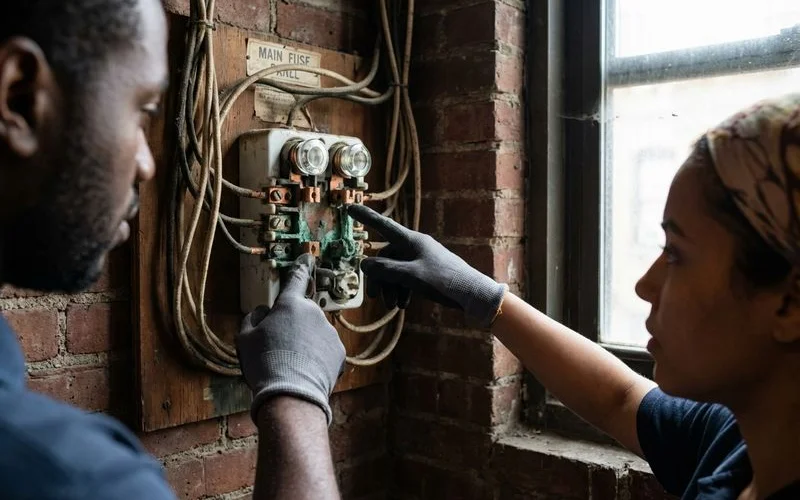
Once a fuse blows, it is done. You must unscrew it, identify the correct replacement, and install a new one. In many older Brooklyn homes, we still see the original Edison-base (Type T) fuses. These are particularly tricky because they allow any amperage fuse to fit into any socket. This design flaw often leads to the dangerous “over-fusing” mistake, where a homeowner unknowingly installs a 30-amp fuse into a slot designed for 15 amps, stripping away the circuit’s only safety net.
How Circuit Breakers Work
Modern circuit breaker panels use electromagnetic switches that automatically “trip” when they detect an overload or a short circuit. The fundamental difference is recoverability. When a breaker trips, you don’t need a trip to the hardware store; you simply flip the switch back to the “ON” position.
Beyond convenience, modern panels introduce active safety monitoring. While a fuse only reacts to heat (overload), modern breakers can detect dangerous anomalies. For instance, Arc-Fault Circuit Interrupters (AFCIs) are now required by the NYC Electrical Code for most living areas. These smart breakers can detect the unique electrical signature of a sparking wire—like a nail hitting a cable behind your drywall—and shut off power before a fire starts.
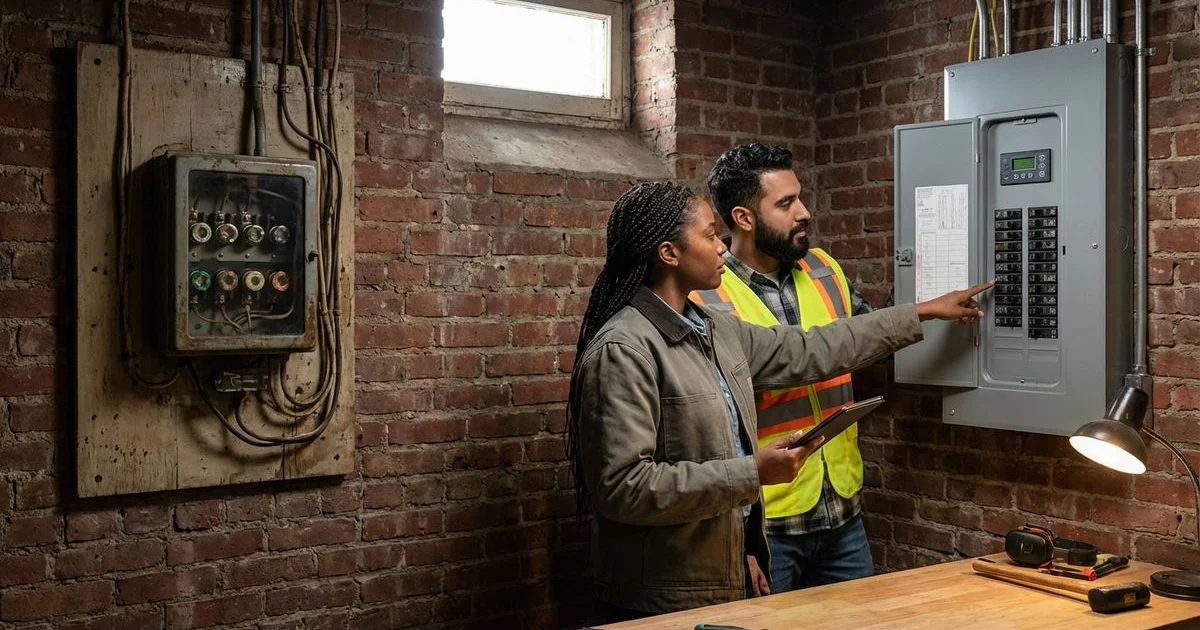
At a Glance: Fuse Boxes vs. Modern Breakers
| Feature | Vintage Fuse Box | Modern Circuit Breaker Panel |
|---|---|---|
| Reset Method | Replace physically (single-use) | Flip switch (reusable) |
| Protection Type | Thermal only (overload/heat) | Thermal, Magnetic, & Electronic |
| GFCI Support | No (requires outlet-level retrofit) | Yes (integrated into breaker) |
| AFCI Support | No | Yes (Code requirement for bedrooms) |
| Typical Amperage | 60 Amps (rarely 100) | 200 Amps (Standard) |
Safety Risks of Fuse Boxes
Fuse boxes carry significant risks that go beyond just “old technology.” The most alarming issue we encounter in Brooklyn basements is “over-fusing.” This happens when a frustrated homeowner replaces a blown 15-amp fuse with a 20-amp or 30-amp fuse to stop it from popping. While this keeps the power on, it allows the old cloth-covered wiring in your walls to carry more current than it was rated for. The result is wires that heat up like toaster coils inside your walls, invisible until smoke appears.
Another critical risk is simply age. Most fuse boxes in NYC were installed between 1920 and 1960. After 60+ years, the internal bus bars corrode, and the screw connections loosen due to decades of thermal expansion and contraction. These loose connections create resistance, which generates heat—a phenomenon known as a “hot spot.”
According to the National Fire Protection Association (NFPA), electrical distribution systems are the third leading cause of home structure fires in the U.S., accounting for roughly 30,000 fires annually. A significant portion of these occur in older homes where the electrical system has been pushed beyond its safe limits.
Limited Capacity for Modern Living
Most fuse boxes in Brooklyn provide only 60 amps of electrical service. To put that in perspective, a modern 200-amp service is the standard for new construction. When these fuse boxes were installed, the average home might have had a radio, a few lights, and a refrigerator.
Today, a single central air conditioning unit can draw 20-30 amps. Add an electric oven, a dryer, and the family’s collection of smartphones and laptops, and you are mathematically out of power.
Consider the load of common modern upgrades:
- Induction Cooktop: 40-50 Amps
- Level 2 EV Charger: 30-50 Amps
- Central AC / Heat Pump: 20-60 Amps
- Electric Dryer: 30 Amps
If you have a 60-amp panel, installing just one of these modern appliances often requires a full service upgrade. We often see homeowners using dangerous workarounds, like running extension cords across rooms or using “cheater plugs,” which bypass grounding safety features.
Insurance and Real Estate Implications
Insurance companies are increasingly risk-averse when it comes to older electrical systems. Major carriers like State Farm, Allstate, and Travelers often require a “4-Point Inspection” for homes over 40 years old. If that inspection reveals a fuse box, you may face:
- Automatic Denial: Some carriers will simply refuse to write a new policy until the box is replaced.
- Premium Surcharges: You might find coverage, but at a premium that is 10-20% higher than a home with breakers.
- Exclusion Clauses: The policy might cover the home but specifically exclude damages caused by electrical fires.
When it comes to selling your Brooklyn home, a fuse box is a massive red flag. In our experience working with real estate agents, buyers use this as a primary negotiating lever. A savvy buyer’s home inspector will flag the panel as “obsolete,” and the buyer will often demand a credit of $3,000 to $5,000 off the closing price—often more than it would have cost you to upgrade it yourself.
Benefits of Upgrading to a Circuit Breaker Panel
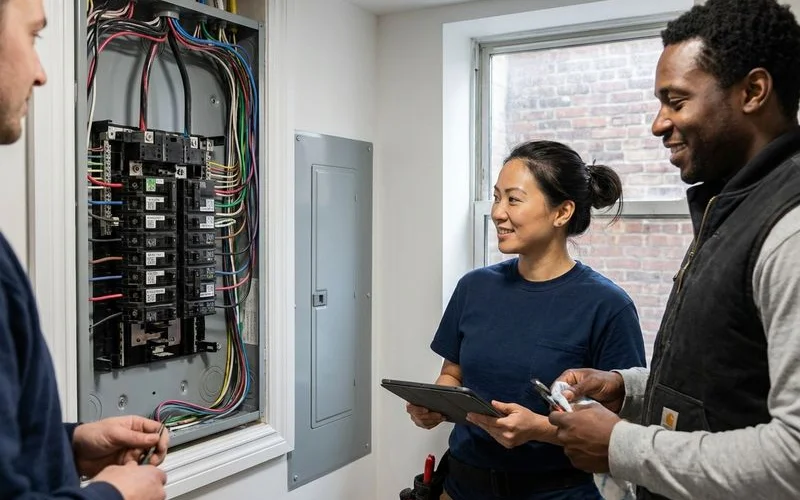
Upgrading to a modern circuit breaker panel isn’t just a repair; it’s an investment in the usability of your home. The most immediate benefit is compliance with the 2020 National Electrical Code (NEC), which NYC largely follows. Modern panels allow for the installation of AFCI breakers, which protect against the types of arcing faults that are common in old Brooklyn wiring (often called “BX” or armored cable).
Capacity is the other game-changer. Moving from 60 amps to 200 amps opens the door for:
- Central Air Conditioning (Split units or ducted)
- Electric Vehicle Charging (Crucial for driveway owners in Queens/Brooklyn)
- Home Office Suites (Dedicated circuits for computers and servers)
Financially, the upgrade pays off. Data from real estate appraisals suggests that homes with updated electrical systems sell faster and retain more value. You are effectively removing a “fear factor” for potential buyers who are terrified of old wiring.
The Upgrade Process
Replacing a fuse box in NYC is a regulated process that involves coordination between your licensed electrician, the Department of Buildings (DOB), and Con Edison. It is not a DIY job.
Here is the typical workflow we follow:
- Filing: We file an electrical work permit with the NYC DOB.
- Coordination: We submit a “load letter” to Con Edison to request the service upgrade (e.g., boosting the line from the street to your meter).
- The Swap: On the scheduled day, power is cut. We remove the old fuse box, install the new breaker panel, and ground the system to the water main (a critical safety step often missing in old homes).
- Inspection: An independent electrical inspection is performed to close out the permit.
The physical installation typically takes one full day (8-10 hours). However, the administrative timeline with Con Edison—getting them to upgrade the service line coming into your building—can take significantly longer, sometimes 3-6 months depending on their backlog. This is why we recommend starting the process before you absolutely need it.
Timing Your Upgrade
If you are planning a kitchen renovation or adding a bathroom, that is the perfect time to upgrade your panel. In fact, under NYC code, significant renovations often trigger a requirement to bring the electrical service up to current standards.
Don’t wait for a failure. Emergency panel replacements are significantly more expensive because they require expedited permits and after-hours labor. By planning ahead, you can schedule the work during a shoulder season (Spring or Fall) and avoid the stress of losing power during a July heatwave or a January freeze.
Contact our team to schedule a detailed assessment. We handle electrical panel upgrades from start to finish—checking your current load, inspecting the service entrance cable, and giving you a clear roadmap for bringing your Brooklyn home’s power into the 21st century.
Related Service
Learn more about our panel upgrades service