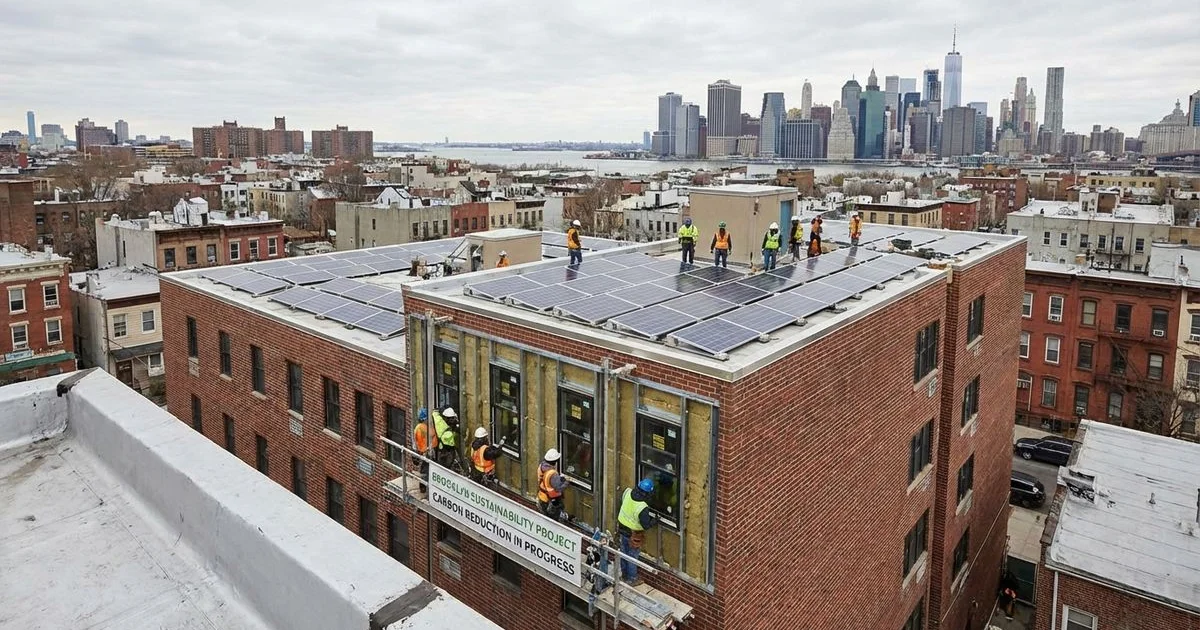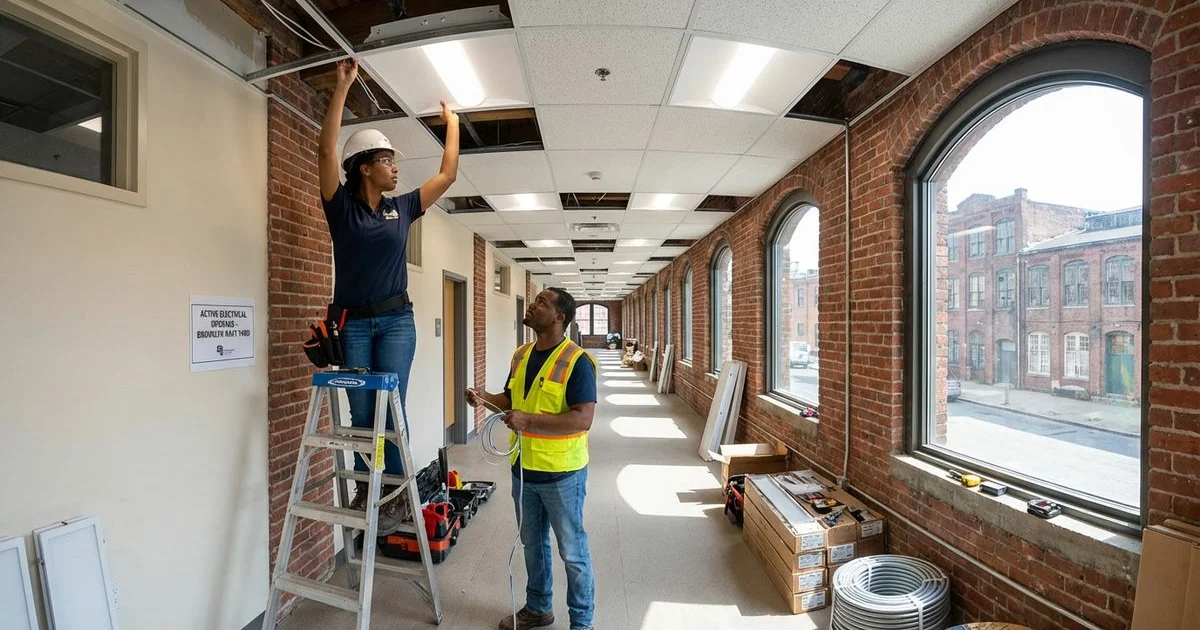
We know that navigating the complexities of New York City building regulations can feel like a full-time job. With the final 2025 deadline now behind us, Local Law 88 (LL88) has shifted from a future concern to an immediate liability for many property owners. Our team frequently encounters Brooklyn landlords who are surprised to learn that their “functional” lighting systems are now officially non-compliant.
This regulation isn’t just about changing a few lightbulbs. It mandates specific, measurable upgrades to your building’s infrastructure that directly impact your operating costs and legal standing. We have helped dozens of clients in Downtown Brooklyn and DUMBO bring their properties up to code, often discovering that the required changes actually pay for themselves faster than expected.
Here is the breakdown of exactly what you need to know, how to check if your building is at risk, and the steps to take right now.
What Is Local Law 88?
Local Law 88 functions as a critical component of the city’s Greener, Greater Buildings Plan, originally enacted back in 2009. We view it as the “hardware update” for NYC’s older building stock. While Local Law 97 gets all the headlines for its carbon caps, LL88 focuses strictly on the physical equipment inside your property.
The law imposes two specific mandates on commercial buildings larger than 25,000 square feet:
- Mandatory Lighting Upgrades: You must upgrade lighting in non-residential spaces to meet the current standards of the New York City Energy Conservation Code (NYCECC).
- Electrical Sub-metering: You must install individual sub-meters for any commercial tenant space larger than 10,000 square feet.
Our experience shows that many owners assume they are compliant because they did a renovation five years ago. This is often a mistake. The code requirements for controls and sensors have tightened significantly, meaning even relatively modern systems might fail an audit.
Which Brooklyn Buildings Must Comply?
We find that confusion often arises around which specific properties are “covered buildings” under this law. The rule generally applies to any building over 25,000 square feet, but there are nuances for properties on shared tax lots.
Properties most likely to be affected include:
- Commercial Hubs: Office buildings in Downtown Brooklyn, DUMBO, and the BAM Cultural District.
- Mixed-Use Developments: Buildings in Williamsburg or Park Slope with large retail ground floors (the residential portion is exempt from lighting rules, but the retail is not).
- Converted Industrial Spaces: Former warehouses in Bushwick or the Navy Yard that have been repurposed as offices or studios.
- Retail Centers: Large shopping complexes and standalone department stores along Kings Highway or Flatbush Avenue.
Our technicians always remind clients that the lighting requirement applies to all non-residential areas. This includes the obvious spots like offices and stores, but also the “back of house” areas like stairwells, basements, mechanical rooms, and parking garages.
Understanding the Lighting Requirements
We approach LL88 compliance by auditing three distinct categories: power density, controls, and automatic shutoff. The goal is to ensure your building stops burning electricity when no one is around.
Power Density Limits
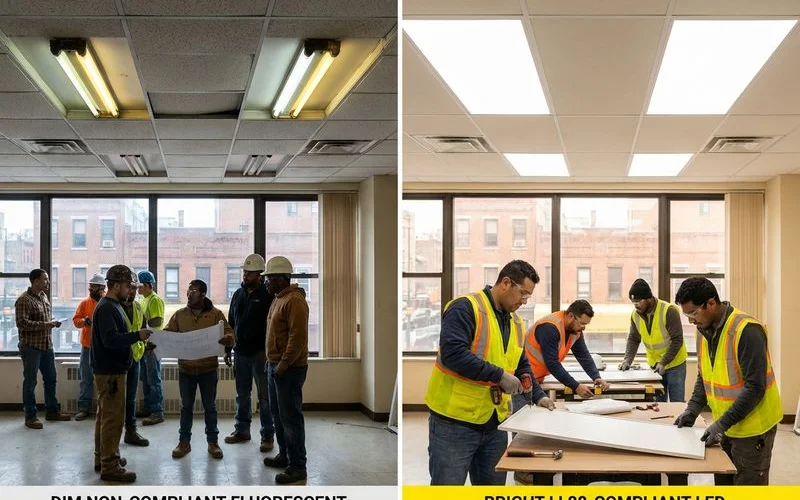
The core of the law requires your lighting system to sip energy rather than gulp it. We measure this in watts per square foot, and the difference between old and new systems is stark.
| Space Type | Old Standard (Typical T12/T8) | LL88 Target (NYCECC Limit) |
|---|---|---|
| Office | 1.5 - 2.0 watts/sq ft | ~0.82 watts/sq ft |
| Retail | 2.5 - 3.0 watts/sq ft | ~1.06 watts/sq ft |
| Corridors | 1.0 - 1.5 watts/sq ft | ~0.66 watts/sq ft |
Advanced Lighting Controls
Our team installs specific control devices to ensure lights are only on when needed.
Occupancy & Vacancy Sensors: You must install sensors in offices, conference rooms, and restrooms that turn lights off automatically. We often recommend “vacancy sensors” (which require manual-on, auto-off) for private offices to prevent lights from triggering falsely when someone just walks past the door.
Daylight Harvesting: Spaces near windows must have sensors that dim the electric lights when natural sunlight is sufficient. This requirement catches many owners off guard, as it often involves rewiring fixtures near the perimeter of the building.
Automatic Shutoff: There must be a system in place to sweep all lights off at a certain time or when the building is empty. Manual switches alone are no longer enough to meet the code in most large commercial spaces.
Exit Signs: We verify that every exit sign draws no more than 5 watts per face. If you still have old incandescent exit signs, they are definitely non-compliant and are costing you about $30 per year each in wasted electricity.
The Sub-Metering Requirement
We see sub-metering as the single most effective tool for resolving landlord-tenant energy disputes.
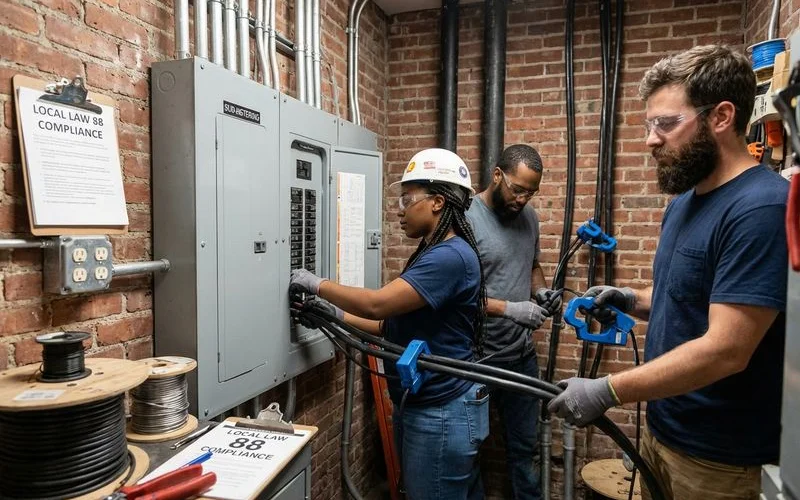
The Mandate: Any tenant space over 10,000 square feet must have its own meter. This meter must measure consumption for that specific tenant, allowing them to be billed for exactly what they use.
The Strategy: Our electricians typically install digital sub-meters that integrate with a Building Management System (BMS). Unlike old mechanical dials, these digital units can send real-time data to a dashboard. This allows you to generate automated monthly bills without sending a super into every closet to read a meter manually.
The Hidden Value: Tenants who pay for their own electricity use about 20% less on average. This reduction lowers the load on your building’s infrastructure and can extend the life of your transformers and panels.
Compliance Process and Documentation
We guide our clients through a standardized four-step process to ensure nothing falls through the cracks.
1. Assessment and Design
A Registered Design Professional (RDP)—an architect or engineer—must audit your current setup. Our partners perform a room-by-room walkthrough to inventory every fixture and switch.
2. Implementation
Licensed electricians (like us) perform the actual upgrades. This might involve retrofitting LED kits into existing troffers to save money, or replacing fixtures entirely for a more modern look.
3. Department of Buildings Filing
Your RDP must file a compliance report with the NYC Department of Buildings (DOB). We ensure that all electrical permits are closed out properly before this filing happens, as open permits can trigger a rejection.
4. Ongoing Records
You must keep the “As-Built” drawings and certification on site. Inspectors may ask for these documents during routine safety checks, even years later.
Penalties for Non-Compliance
We cannot overstate the financial risk of ignoring this law. The penalties are structured to be painful enough to force action.
The Cost of Inaction: The standard penalty for failing to file a compliance report is $1,500. However, the violations for the building condition itself can escalate to $3 per square foot per year. For a 50,000-square-foot building in Sunset Park, that could theoretically mean $150,000 in annual fines until the issue is fixed.
Beyond the Fine: Our clients also face pressure from lenders. Banks are increasingly asking for proof of LL88 compliance during refinancing deals. A non-compliant building is seen as a liability, which can hurt your valuation or stall a sale.
How LL88 Connects to Local Law 97
We often explain to property owners that LL88 is essentially the “warm-up” for Local Law 97. While LL88 mandates specific equipment, LL97 sets strict limits on your building’s total carbon emissions.
Lighting upgrades are the most cost-effective way to lower your carbon score. By cutting your lighting energy use in half (which is typical with an LED retrofit), you directly reduce the emissions that LL97 measures.
Our analysis shows that for many commercial buildings, a comprehensive LL88 lighting upgrade can reduce total building energy consumption by 10-15%. This creates a massive buffer against future LL97 carbon penalties, solving two problems with one project.
Taking the Next Step
We know that receiving a violation notice is stressful, but the solution is straightforward. The technology to comply is readily available, and the long-term energy savings are guaranteed.
The first step is to verify your building’s status. Check your property records to see if a compliance report was filed by the 2025 deadline. If not, you need to initiate an audit immediately to stop the clock on potential penalties. Our team handles complete NYC LL88 and LL97 compliance projects from audit through DOB filing.
Our team at Brooklyn Electrical Experts specializes in LL88 compliant lighting upgrades and sub-meter installations for Brooklyn commercial buildings. We work closely with registered design professionals to ensure that every project meets the technical requirements of the law while maximizing the energy savings and operational benefits for building owners. Contact us for a compliance assessment of your Brooklyn property.
Related Service
Learn more about our nyc compliance ll88 ll97 service