Local Law 97 is the most ambitious building emissions legislation in any major city in the world, and it directly affects thousands of Brooklyn building owners. Enacted as part of New York City’s Climate Mobilization Act in 2019, LL97 sets strict carbon emission limits for buildings over 25,000 square feet. With the first compliance period already underway and penalties being assessed, Brooklyn building owners need to understand exactly what is required and what steps to take now.
What Is Local Law 97?
Local Law 97 requires large buildings in New York City to meet progressively stricter greenhouse gas emission limits. The law covers approximately 50,000 buildings across the five boroughs, representing about 60 percent of the city’s total building square footage. In Brooklyn, this includes large residential buildings, commercial office spaces, mixed-use properties, hospitals, schools, and cultural institutions.
The core mechanism is straightforward: each building is assigned a carbon emission limit based on its size and occupancy type, measured in metric tons of CO2 equivalent per square foot per year. Buildings that exceed their limits face significant financial penalties.
Compliance Periods and Emission Limits
LL97 implements its requirements in two major phases:
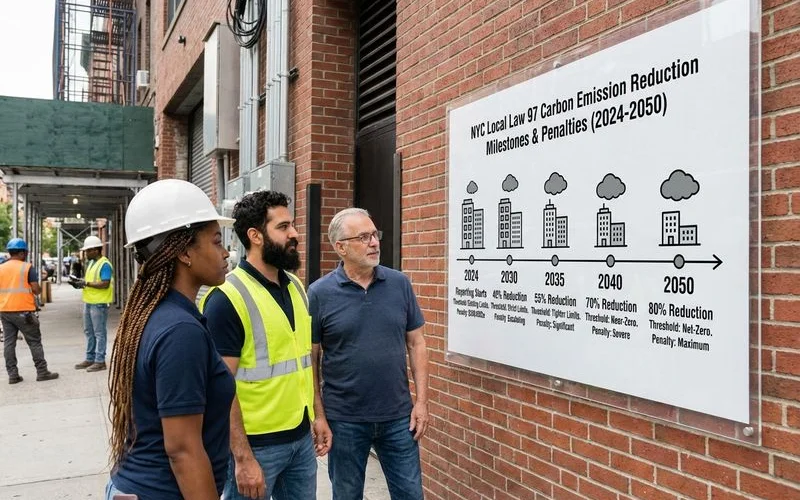
2024 to 2029 (First Compliance Period): Buildings must meet initial emission limits, which require roughly a 40 percent reduction from 2005 baseline levels. These limits are relatively achievable for well-maintained buildings through operational improvements and equipment upgrades.
2030 to 2034 (Second Compliance Period): Much stricter limits take effect, requiring approximately 80 percent reduction from 2005 levels. Meeting these targets will require significant capital investments in building systems for most properties.
The emission limits vary by building type. For example, offices have different limits than residential buildings, hospitals, or retail spaces. Buildings with multiple use types calculate their limits based on the proportion of each use type.
How Penalties Work
The penalty structure is designed to incentivize compliance through financial consequences:
$268 per metric ton of CO2 equivalent over the limit, per year. This is not a one-time fine. It is assessed annually for every year the building exceeds its limit. For a large Brooklyn building that exceeds its limit by 500 metric tons, the annual penalty would be $134,000. Over the six-year first compliance period, that adds up to $804,000.
These penalties cannot be passed through to tenants in rent-regulated buildings, meaning the building owner bears the full cost. The penalties are also not tax-deductible as a business expense, making them even more painful from a financial perspective.
Which Brooklyn Buildings Are Affected?
Local Law 97 applies to buildings that meet any of the following criteria:
Buildings over 25,000 gross square feet are covered. This includes a significant number of large residential buildings, commercial properties, and mixed-use buildings throughout Brooklyn neighborhoods like Downtown Brooklyn, Brooklyn Heights, Williamsburg, DUMBO, Park Slope, and Fort Greene.
Buildings that are part of a lot with a combined gross floor area exceeding 50,000 square feet across two or more buildings on the same tax lot are also covered.
Certain building types have limited exemptions or alternative compliance paths, including houses of worship (partially exempt), affordable housing under certain programs, and city-owned buildings (which have different compliance mechanisms).
Practical Strategies for Brooklyn Building Owners
Reducing your building’s carbon emissions to comply with LL97 involves addressing the major energy consumers in your building. Here are the most effective strategies:

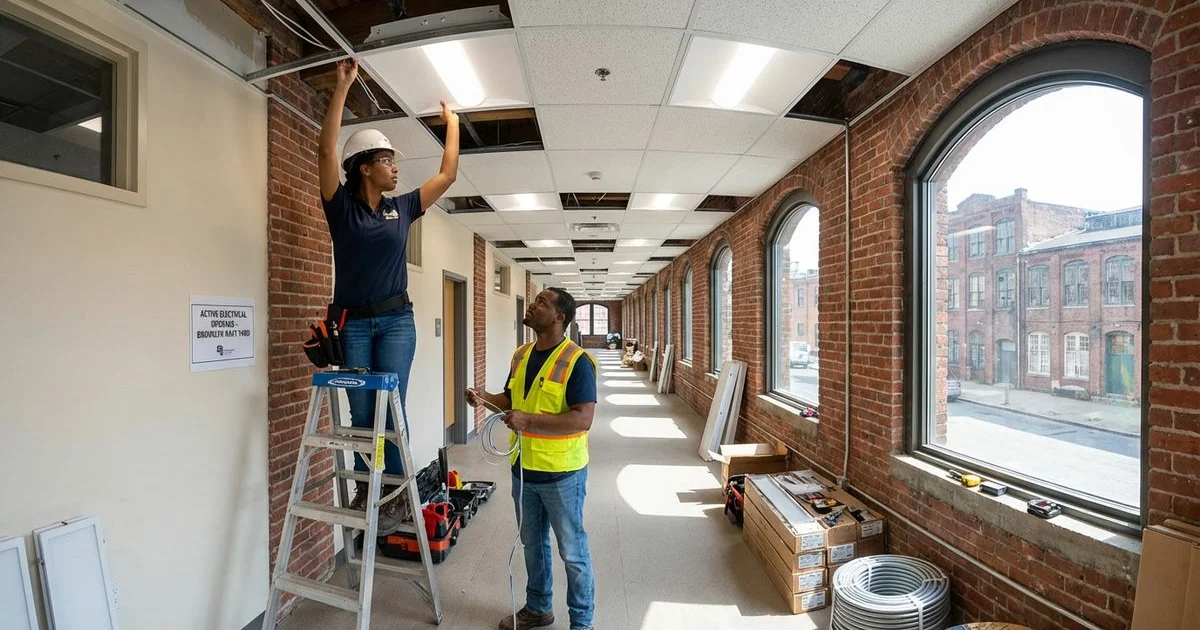
Lighting upgrades. Replacing outdated fluorescent and incandescent lighting with LED fixtures is one of the fastest and most cost-effective ways to reduce emissions. A commercial LED retrofit typically reduces lighting energy consumption by 50 to 75 percent with a payback period of two to three years. This directly translates to lower carbon emissions for your building. For buildings also subject to Local Law 88, lighting upgrades serve double duty by satisfying both LL88 and LL97 requirements simultaneously.
Building envelope improvements. Upgrading insulation, sealing air leaks, and installing energy-efficient windows reduces heating and cooling loads. While these improvements have longer payback periods, they deliver lasting emission reductions.
HVAC system optimization. Upgrading to high-efficiency heating and cooling systems, implementing building management systems for automated temperature control, and ensuring regular maintenance all contribute to emission reductions.
Electrification. Replacing fossil fuel-burning systems (oil or gas boilers) with electric heat pumps eliminates direct on-site emissions. As New York’s electrical grid becomes cleaner over time, the emission factor for electricity decreases, making electrification an increasingly effective strategy.
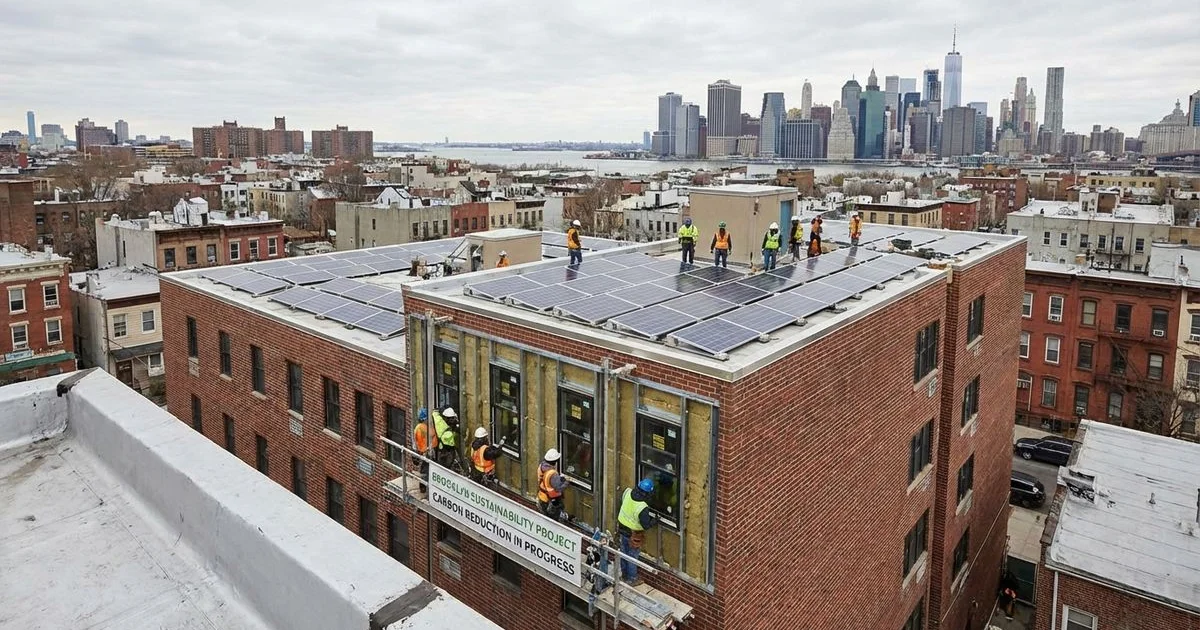
On-site renewable energy. Installing rooftop solar panels reduces your building’s reliance on grid electricity and lowers its carbon footprint. Brooklyn’s many flat-roofed buildings are often good candidates for solar installations.
Purchasing renewable energy credits. LL97 allows buildings to offset up to a limited percentage of emissions through the purchase of renewable energy credits. This can be a bridge strategy while physical improvements are being planned and implemented.
Getting Started: The Energy Audit
The essential first step for any Brooklyn building owner subject to LL97 is a comprehensive energy audit. This audit establishes your building’s current energy consumption baseline, calculates your current carbon emissions, compares your emissions to your LL97 limit, identifies the most cost-effective improvement opportunities, and creates a prioritized roadmap for reaching compliance.
New York City offers resources through the NYC Accelerator program to help building owners plan and finance their compliance improvements. Additionally, Local Law 87 requires buildings over 50,000 square feet to undergo energy audits and retro-commissioning every ten years, providing a natural starting point for LL97 planning.
Financing Options
The capital investment required for LL97 compliance can be substantial, but several financing mechanisms are available to Brooklyn building owners:
PACE financing (Property Assessed Clean Energy) allows building improvements to be financed through a special assessment on the property tax bill, with repayment terms up to 20 years. The financing stays with the property if it is sold.
C-PACE (Commercial PACE) is available for commercial properties in New York City and can cover up to 100 percent of eligible improvement costs.
Green bonds and ESG-focused lending are increasingly available from banks and financial institutions that recognize the growing importance of building sustainability.
Con Edison incentives provide rebates and incentives for many qualifying energy efficiency improvements, reducing the net cost of compliance projects.
The Cost of Inaction
The financial case for proactive LL97 compliance is clear when you consider the alternative. Penalties accumulate annually and can reach millions of dollars over a compliance period for a single building. Beyond the direct penalty costs, non-compliant buildings face increasing challenges attracting and retaining quality tenants, as corporate tenants increasingly require LL97 compliance as a condition of their leases. Property values for non-compliant buildings will decline as buyers factor in the cost of achieving compliance or paying ongoing penalties.
Take Action Now
Whether your Brooklyn building needs a comprehensive emissions reduction plan or specific improvements like lighting upgrades and electrical system optimization, starting now gives you the most time and the most options for achieving compliance cost-effectively. Our team at Brooklyn Electrical Experts specializes in NYC LL88 and LL97 compliance, helping building owners implement lighting upgrades, electrical system improvements, and EV charging infrastructure that all contribute to lower emissions and regulatory compliance.
Related Service
Learn more about our nyc compliance ll88 ll97 service