A well-lit exterior is one of the most effective deterrents against property crime. In Brooklyn, where homes range from classic brownstones with stoops to modern townhouses with private gardens, outdoor lighting serves the dual purpose of enhancing security and adding curb appeal. The right outdoor lighting setup makes your property less attractive to intruders while making it more inviting for you, your family, and your guests. Here are the best outdoor lighting strategies for Brooklyn homes.
Why Outdoor Lighting Is Essential for Security
Darkness provides cover for criminal activity. Burglars and package thieves prefer poorly lit properties because they can approach, attempt entry, and leave without being easily seen by neighbors or passersby. Research consistently shows that well-lit properties experience significantly less crime than those with dark exteriors. In Brooklyn’s dense urban environment, where neighbors are close and foot traffic is constant, good outdoor lighting leverages the natural surveillance of your neighborhood. When your property is well lit, anyone approaching it is visible to the people around you, which is a powerful deterrent.
The Science of Contrast and Coverage
Effective security lighting isn’t just about brightness; it’s about eliminating shadows. We often see homeowners make the mistake of installing a single, blindingly bright floodlight. This actually creates deep, pitch-black shadows where intruders can hide, a phenomenon known as high-contrast blindness. Instead, you need overlapping layers of softer light.
By using multiple lower-lumen fixtures (around 400-600 lumens each), you create a wash of light that eliminates dark corners. Our team focuses on “uniformity ratios,” ensuring that the difference between your brightest and darkest spots isn’t extreme. This allows your eyes—and your security cameras—to capture detail across the entire property rather than just a single bright spot.
Front Entrance and Stoop Lighting
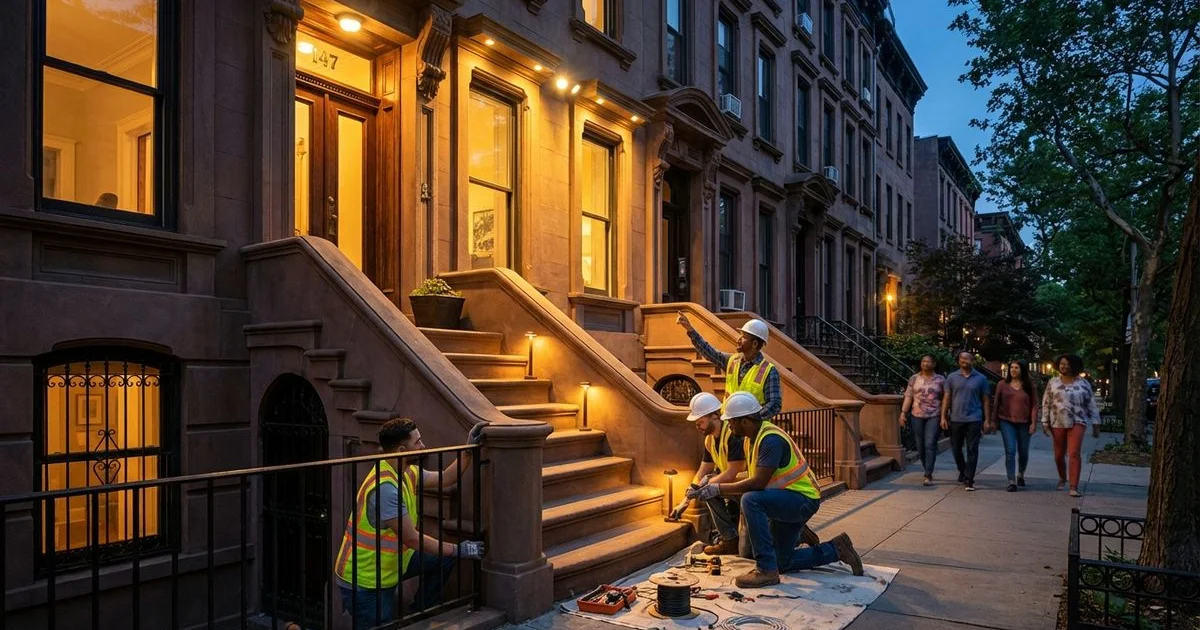
The front entrance is the most important area to illuminate on any Brooklyn home. For brownstones and rowhouses with stoops, this means lighting the stoop itself, the front door, and the sidewalk area at the base of the steps. Wall-mounted sconces on either side of the front door provide balanced illumination and a welcoming appearance. Choose fixtures with an output of at least 700 lumens, equivalent to a 60-watt incandescent bulb, to ensure the area is bright enough for security purposes while not being harsh or glaring. For homes with recessed entries or covered vestibules, a ceiling-mounted fixture directly above the door provides focused downlight on anyone standing at the entrance.
Navigating Landmark Regulations
If you live in one of Brooklyn’s many historic districts, you must comply with Landmarks Preservation Commission (LPC) guidelines. We regularly work with these regulations, which often prohibit drilling into the face of the brownstone or brick.
The approved method typically involves mounting fixtures into the mortar joints or wood door frames to preserve the masonry. You should also look for fixtures that conceal the bulb source, as the LPC often rejects lights that cause excessive modern glare on historic facades. Brands like Bevolo or Northeast Lantern offer electric versions of classic gas lanterns that satisfy these strict aesthetic codes while providing modern LED efficiency.
Motion-Sensor Lighting
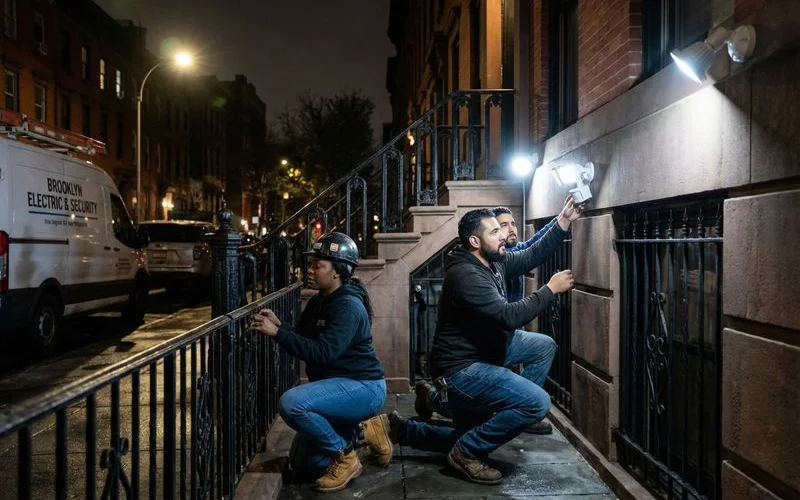
Motion-activated lights are among the most effective security lighting options because they draw attention to movement around your property. When someone approaches and the lights suddenly turn on, it creates a startling effect that discourages unwanted visitors while alerting you and your neighbors to activity. Modern LED motion sensor lights are highly configurable, allowing you to adjust the detection range, sensitivity, duration, and brightness to suit your property’s specific needs.
For Brooklyn brownstones, motion sensor lights work particularly well in several locations. Mount them at the top of the stoop to illuminate anyone climbing the steps. Install them at garden level to cover the basement entrance and any under-stoop areas. Place them in backyards and rear garden areas that are not visible from the street. Position them near garage doors or parking areas if your property has them. The key is to cover all approaches to your home so that no one can reach an entry point without triggering a light.
Solving the “Sidewalk Trigger” Problem
A common annoyance in Brooklyn is motion lights that trigger every time a pedestrian walks past your house. To fix this, we recommend fixtures with “dual-zone” technology or physical masking shutters.
These features allow you to block out the street-facing portion of the sensor’s view. Your light will only activate when someone crosses the property line onto your stoop or into your areaway.
| Feature | Standard Sensor | Advanced “Masking” Sensor |
|---|---|---|
| Detection Arc | 180° (Hits sidewalk) | Adjustable (Focuses on property) |
| False Alarms | High (Cars, pedestrians) | Low (Only visitors) |
| Best For | Backyard / Garage | Front Stoop / Street-facing |
Pathway and Garden-Level Lighting
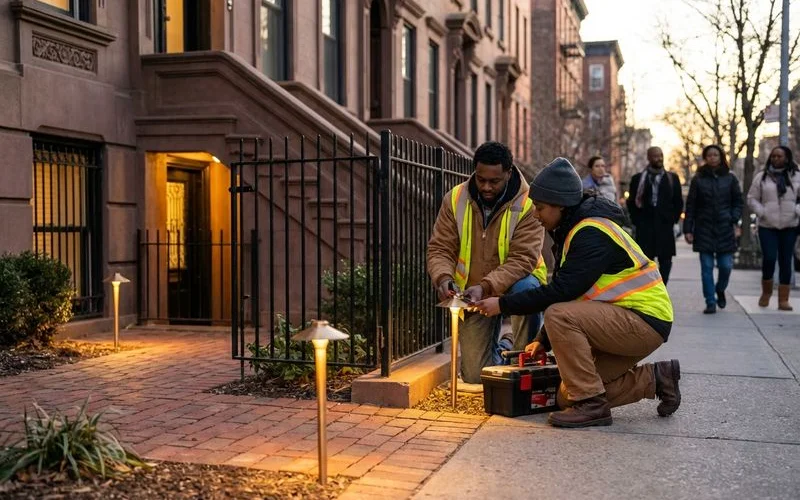
Many Brooklyn homes have garden-level entrances, courtyards, or walkways that lead to basement apartments or rear yards. These areas are often the most vulnerable because they are below street level and out of direct sight from the sidewalk. Low-voltage LED pathway lights along walkways and steps provide continuous illumination that makes these areas safer for residents and less appealing to intruders. Bollard-style path lights or recessed step lights built into the risers of garden-level stairs are both practical and architecturally attractive options.
The Low-Voltage Advantage
For garden levels, we almost exclusively recommend 12-volt (low-voltage) systems over standard 120-volt wiring. Safety is the primary reason; if a wire is accidentally cut by a shovel or garden tool, the risk of shock is virtually non-existent.
Installation is also far less invasive. We don’t need to dig deep trenches that might damage historic bluestone pavers or mature root systems. The cables can be tucked shallowly along planter beds or under mulch.
Pro Tip: Use “warm white” LEDs (2700K-3000K) for pathways. Cooler “daylight” bulbs (5000K) can look like an airport runway and wash out the natural colors of your brick and planting.
Smart Outdoor Lighting Systems
Smart lighting technology has transformed outdoor security lighting by giving homeowners remote control, automation, and integration with other security systems. Smart outdoor lights connect to your home’s Wi-Fi network and can be controlled from your smartphone, allowing you to turn lights on and off, adjust brightness, and set schedules from anywhere. This is particularly valuable for Brooklyn homeowners who travel frequently, as you can ensure your property appears occupied even when you are away.
Many smart outdoor lighting systems integrate with security cameras and doorbell cameras, automatically turning on when motion is detected and providing better illumination for camera footage. You can also set up automated routines that turn lights on at sunset and off at sunrise, or that simulate random patterns of occupancy when you are on vacation. Some systems even allow you to set up geofencing so your outdoor lights turn on automatically when you arrive home and turn off when you leave.
Overcoming the “Faraday Cage” Effect
Brownstones are built with thick masonry walls that are notorious for blocking Wi-Fi signals. We often see homeowners install smart bulbs that constantly disconnect because the router signal can’t punch through three layers of brick.
The solution is to use a system that relies on a lower frequency mesh network rather than direct Wi-Fi. Lutron Caseta is the gold standard here; it uses a proprietary frequency (Clear Connect) that penetrates brick and plaster exceptionally well. By installing a single smart switch inside the house to control your outdoor fixtures, you get reliable smart control without needing expensive Wi-Fi boosters outdoors.
Backyard and Rear Garden Security
Brooklyn backyards and rear gardens require their own lighting strategy. These private outdoor spaces are often accessible from alleyways or neighboring properties, making them potential entry points. Flood lights mounted high on the rear wall of your home provide broad coverage of the entire yard. For a more subtle approach, landscape lighting that illuminates the perimeter of the yard with uplights and spotlights creates a beautiful ambiance while ensuring there are no dark hiding spots along fences or walls.
Perimeter Protection vs. Light Trespass
While you want security, you also need to respect your neighbors in the dense “donut” of a Brooklyn block. NYC regulations prohibit light from shining directly into a neighbor’s window.
We recommend using “dark sky compliant” fixtures that direct light downward, not outward. This keeps the light focused on your fence line—where an intruder would enter—without flooding your neighbor’s bedroom.
- Zone 1: The immediate back door (Bright, motion-activated).
- Zone 2: The fence line (Softer, continuous uplighting on trees or walls).
- Zone 3: The center yard (Darker to create depth and reduce light pollution).
Dusk-to-Dawn Lighting
Dusk-to-dawn fixtures use built-in photocells to automatically turn on at sunset and off at sunrise. These provide consistent overnight illumination without requiring you to remember to flip a switch or program a timer. For areas that benefit from continuous lighting, such as the front stoop, house numbers, and primary entry paths, dusk-to-dawn fixtures are a reliable and low-maintenance option. LED versions consume very little electricity, often less than $10 per year per fixture, making them an extremely cost-effective security measure.
Avoiding the “Strobe Light” Effect
A frequent issue with photocells is improper placement. If the sensor sees the light from its own bulb (or a streetlight), it will turn off, get dark, turn back on, and cycle endlessly.
We install photocells facing north or away from artificial light sources whenever possible. For the most reliable performance, consider an astronomical timer switch (like the Honeywell Econoswitch) instead of a photocell. These replace your indoor wall switch and automatically adjust for sunset times based on your longitude and latitude, completely eliminating sensor issues.
Lighting Your House Numbers
A simple but often overlooked security measure is ensuring your house number is well lit and clearly visible from the street. Emergency responders need to find your address quickly, and a lit house number makes this possible even in the dark. Backlit address plaques, illuminated number tiles, or a small spotlight aimed at your house number all serve this purpose. NYC building codes require visible address numbers on all residential buildings, and illumination makes them functional around the clock.
Compliance with NYC Fire Code
Under NYC Fire Code § 505.1, premises identification must be legible from the street. In a dense row of houses, a dark address can cost ambulance or fire crews vital seconds.
Options range from modern LED-backlit numbers to discreet “pin spots.” A pin spot is a tiny, focused beam mounted on an eave or overhang that highlights the numbers without spilling light elsewhere.
Electrical Considerations for Outdoor Lighting
All outdoor electrical installations in Brooklyn must use weather-rated components and comply with NYC electrical codes. Outdoor outlets and junction boxes must be GFCI protected to prevent shock hazards in wet conditions. Wiring that runs outside or underground must be rated for outdoor use and installed in appropriate conduit. If your home does not currently have outdoor electrical circuits, a licensed electrician can add dedicated outdoor circuits from your panel. This is also an excellent time to evaluate whether your electrical panel has sufficient capacity for the additional circuits, and if not, to consider a panel upgrade that accommodates both your current and future electrical needs.
Conduit Requirements in NYC
Unlike some suburbs where plastic PVC conduit is common, NYC code often necessitates more durable protection due to physical density and potential for damage. We typically use Rigid Metal Conduit (RMC) or Intermediate Metal Conduit (IMC) for any wiring exposed on the building facade, especially at lower levels where it could be bumped by trash cans or pedestrians.
Waterproofing is equally critical. “In-use” covers (often called bubble covers) are mandatory for outdoor outlets. These allow you to keep a device plugged in while the cover is locked shut, preventing water ingress that trips your GFCI breaker during a rainstorm.
Planning Your Outdoor Lighting
The most effective outdoor lighting plan considers your property’s specific layout, vulnerabilities, and aesthetic preferences. Walk around your property after dark and note every area that feels dark or hidden. Consider which entry points are most accessible and least visible from the street. Think about how you use your outdoor spaces and where better lighting would improve both safety and enjoyment. Our team can conduct an on-site evaluation of your Brooklyn property, identify the best lighting placements, and install a complete outdoor lighting system that enhances security while complementing the character of your home. Contact us to schedule your free outdoor lighting consultation.
Related Service
Learn more about our lighting installation service